

Why you're stuck.
The secret behind every problem holding you back, and how to flip it. No matter your circumstances, nor those in your way, you can overcome. The key is hidden in your brain.

“What could I possibly learn from you? I have kids your age.”
She was standing at the door to his office. Her new boss. Half her age. A total stranger.
What would you have done, were you the new boss, in that situation? Attacked by a “subordinate” disrespecting you before you even knew her name? To be met with complete judgement, assumptions erasing any sacrifices you’ve made or positive ambition within you?
I would have frozen. Been kind but flustered, and overthought it for hours after.
But he did a genius move.
Before I get to that, let’s dig into why the woman acted this way, why most of us would react poorly, and why this is representative of all the problems we get stuck on at work. Yes — ALL of them.
What the heck is happening in our brains?
Ah, the brain.
Behavior confounds us (“why would that crazy lady think it would be good to start her relationship with her new boss that way??”), yet when the brain is explained, our intuition gets it.
So let’s dig into some simplified neuroscience.
May it empower and free you to understand why you do those things you regret, or why you think of the perfect response 3 hours too late.
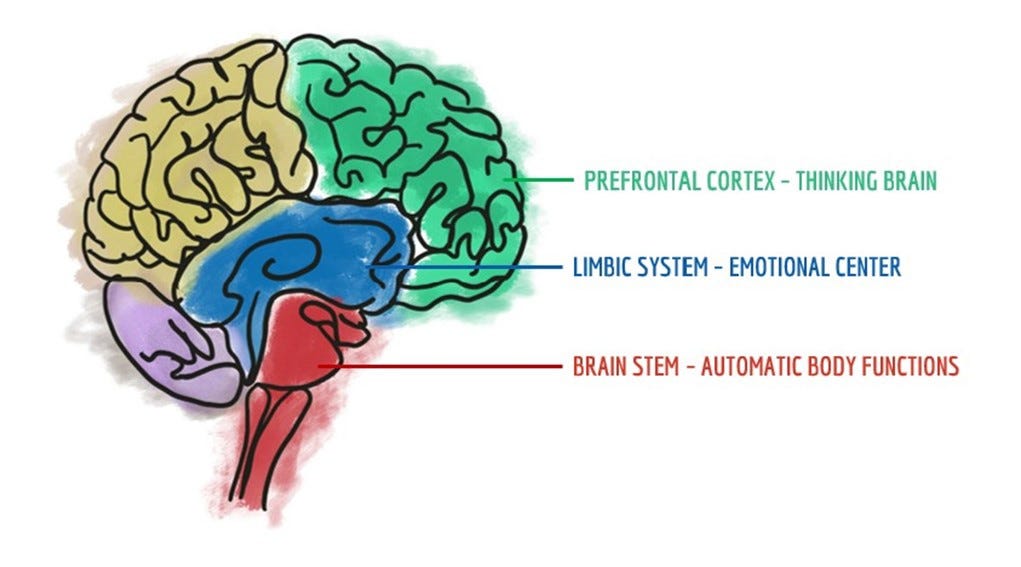
You can sum up the human experience in 3 segments of the brain:
Brain Stem - we’re born with this. It regulates the stuff we don’t think about like breathing and digestion.
Limbic System - evaluates our surroundings for danger, reward, and social meaning, shaping our sense of safety and connection. The limbic system develops in the first 6 years of life, then morphs (typically slowly, though dramatically in trauma) through life experiences. Here’s where you’ve seen it in action:
When a baby cries, how a caregiver does/doesn’t respond teaches the baby—at a nervous-system level—if the world is safe or dangerous and if needs will be met or not.
When a teenager compliments an attractive peer and receives a flirtatious or humiliating response, their limbic system learns about social status and belonging.
In a meeting, if a colleague belittles your suggestion, it is your limbic system that triggers shutdown or an impulsive comment you may later regret.
The limbic system and brain stem work closely together. For example, together they initiate the Fight-or-Flight response that causes immediate bodily reactions, such as in tension our muscles or shallow breathing. You know this well, it’s why anxiety about a big presentation can cause nausea or sweating.
Prefrontal Cortex - develops last, age 2 on. Many call this the “rational” brain where executive function happens. Basically, it gives us what we need for “successful” behaviors:
Language and communication
Complex problem solving skills: abstract thinking, imagination, creativity, planning, envisioning domino-effects into the future, attaching meaning to immense amounts of information
Positive relational capacity: empathetic understanding, perspective-taking
Choice, our free will
All of art, culture and technological innovations are only possible thanks to our prefrontal cortex.
OK, I knew this is nerdy, almost text-book-ish. You’re doing great sticking with me. I have just 2 more critical insights to share about your noggin:
First, the order of development is significant because it reveals the order of prioritization. When a situation happens, the information first hits our limbic system which triggers our brain stem, then takes a few extra moments to hit our prefrontal cortex.
In other words, when triggered, your body reacts before you make a choice. Uh-oh. That’s right.
Lastly, If the trigger is significant enough, your prefrontal cortex “goes offline” so that your entire focus can stay on survival.
These two facts are helpful when a stranger lunges at you and you find yourself sprinting away before you rationally have a clue as to what is happening.
But…not so helpful when you can no longer remember your speaking points in a presentation, or intelligently respond to a surprisingly irritating comment.
What’s sabotaging me?! Is it…me?
Have you ever wondered “why can’t I get it together?” or “what was I thinking?!” “What is wrong with me?!” “Why can’t I be as ____ as that awesome person?”
It’s neuroscience: when you feel a threat, you react before you think.
For all of us, work is a field full of threatening land-mines. You never know when you’ll step on one, but you’re vigilantly aware of dangers.
Why does work heighten our senses? Two reasons:
Our paychecks are how we provide for ourselves, our loved ones and our deepest dreams.
Our jobs are a key outlet of how we find meaning and purpose (or lack thereof) in our lives and our identities.
In other words, when challenges pop up at work, subconsciously (or consciously) we feel a threat to our survival and our value as a human.
So yeah, work is a field of limbic-system-landmines. When we step on one, our ability to think open-mindedly, creatively, sifting through complexity with hope and curiosity — that all vanishes. Boop. Gone.
It’s not hard to think of triggers looming over us all:
budget cuts
missing goals
uncertainty in the market / economy
low trust in leadership
feeling unheard or discouraged from speaking up
Basically - scarcity. Loss of resources, options, autonomy.
We are swimming in an environment of scarcity. Think of all the things you don’t have enough of at work: not enough time, not enough resources like teammates or budget, not enough influence, not enough respect.
This has us teetering on the edge of our limbic system throughout our workday. Like that task you almost finished but didn’t have quit enough time before your meeting started where you don’t have enough information nor enough rapport established with your boss’ boss.
Then drop in conflict. Conflict isn’t just from behaviors that offend; it’s sparked by competing departmental goals (i.e. sales = quantity, engineering = quality) compounded by macro-economic conditions (i.e. tariffs), technological disruption (we’re all behind on using AI), and our own internal beliefs-from-past-experiences (“no one listens to me around here”).
Whew…
It’s a lot.
Ok, but the problem isn’t me - it’s my circumstances.
Fair.
You could argue many of our biggest problems happen to us, out of our control: layoffs, budget cuts, surprise challenges like regulation changes, etc.
It’s true.
But those things are all decisions made by others, and I’m willing to wager that the worst of decisions are made in their limbic brains, too.
Sometimes you can influence those powerful decision makers. Most times, you can’t.
All the time, what you can influence is your strength of response; shaking yourself out of your own fight-flight-freeze response so that you can bring back your imagination, complex problem solving, creativity and relational capacity.
Life will always happen to us.
My sincere hope is that these words inspire and equip you to find your inner strength.
How do we come back?
Let’s revisit our opening scenario of new boss with pissed-off-employee.
We can imagine this woman was solidly operating without her prefrontal cortex. She was threatened, she was fighting (not flighting). She was impulsive and certain (two classic characteristics of a limbic system takeover). Certain that this new boss was no good and certain that he wasn’t going to respect her.
Unexpectedly, his response miraculously brought her executive functioning back online. She entered his office, sat down, shared valuable information, and built deep mutual trust before leaving.
How?!
What could possibly flip such an offensive situation in so toxic an environment?
A simple response:
“You’re right, I probably have a lot I can learn from you.”
In that one statement, he met her where she was, validated her, respected her, and invited her into a positive social connection. This lowered her sense of threat, relaxed the tension, allowing her prefrontal cortex to “wake up.” Positive social interaction sparks activity in this executive functioning part of the brain.
In other words, sincere human connection revives our ability to make choices, operate in ambiguity, practice curiosity, and resolve complex issues.
We know this. It’s so obvious in toddlers. Think of how they are lost in their imaginations, exploring nature, giggling with friends at a park. One falls. Immediate screams. All imagination, social play and curiosity are gone. He runs to his caregiver, who swoops him up. The safety of that embrace soothes his heart, body and mind. It doesn’t take long for him to wiggle out of the arms and back into exploratory fun.
While we don’t scream or embrace at work, hopefully we’ve all experienced when someone believes in us, gives our voice a space, or truly sees us in the midst of a challenge.
Warm relational interaction.
That’s how we can hack our brain out of fight-flight-freeze and back into ideation, complex solutioning, making lemonade out of lemons.
Put it into practice
If you’re a leader - this knowledge is a superpower. It’s how you melt away the tension to bring back executive functioning in your team.
If you have no authority, you still have influence. I’ve seen an intern flip the atmosphere with a simple curious question.
The secret is relational curiosity.
The courage to let the "new" and the "different" make you smarter, not smaller.
It’s the discipline of staying open to people who aren’t like you, recognizing that their differing strengths complete the picture, not overly complicate it.
It’s kindness, creating space despite scarcity, asking inviting questions.
Honoring the intrinsic value in each other.
There are so many tactics and nuances to practicing relational curiosity. It’s what this substack is all about. Upcoming articles include how to win any argument, flipping territorial internal politics into collaboration, why conflict is good, and AI’s power to destroy or enhance human connection.
Please leave comments on what is helpful, request upcoming topics, and ask questions! I sincerely aim to make this empowering to your relational influence and joy.